
- Uncertainty
- Medium
- Decision relevance
- Medium
- Resolvability scale
- Long-term sustained deployment
The Atlantic Meridional Overturning Circulation is a system of ocean currents that moves warm surface water northwards towards the sub-polar Atlantic, and cold deep water southwards. Its strength is in decline (Ceasar et al., 2021) and this is projected to continue under warming (Weijer et al., 2020; Baker et al., 2023), and may be subject to a tipping point beyond which further change would be self-reinforcing leading to long-term collapse (Stommel, 1961; Drijfhout et al., 2025). Collapse or strong weakening of AMOC would cause severe, hemispheric-scale impacts including cooling of Northern Europe and disruption to tropical rainfall (Liu et al., 2017; Rahmstorf et al., 2024). Reducing this risk could therefore be a significant motivating factor for SAI deployment. Current evidence suggests that SAI would likely reduce AMOC decline (Figure 1, below). However, the extent of this reduction, its scenario dependence, and the interaction of SAI with timescales of tipping dynamics is not yet understood.
Metric
Under SAI used to hold global mean temperature at 1.5°C above pre-industrial, beginning in 2035, SAI offsets less than one third of the weakening under the background warming scenario, at 2100.
Uncertainty
While models agree on the sign of SAI’s effect – increasing AMOC strength, or reducing its decline – there is substantial variation between models in the magnitude of SAI’s impact. Subsequent versions of CESM (CESM1-WACCM5 vs CESM2-WACCM6) varied from showing an overestoration of AMOC in response to SAI to showing only a small and partial one (Tilmes et al., 2020), although the whether this represented changes to the model versus the later onset of SAI and more Southern hemisphere heavy injection latitudes in the CESM2-WACCM6 case is not clear (Fasullo and Richter, 2023). In the recent G6-1.5K-SAI and G6-1.5K-HiLLA scenarios, which hold warming at 1.5K above pre-industrial beginning in 2035, as in our metric, we have an assessment available for three models (Smith et al., forthcoming). Across these models, approximately 50% of the decline is offset in two models (CESM2-WACCM and MIROC-ES2H), while approximately all of the decline is offset in the third (UKESM1). As such, based on the present evidence, we see this metric as plausible (>10% chance) but not likely (<50% chance) and assign it a ‘medium’ uncertainty. More broadly, all models share important limitations which may make their AMOC circulation too stable (e.g. a lack of an interactive Greenland Ice Sheet), and the question of dependence of the AMOC response on timing and strength of SAI has been little explored. As such, one should treat current earth system model projects with some caution.
Decision relevance
There is good confidence that SAI would reduce tipping risks associated with AMOC. However, reduction of AMOC tipping risks can feature prominently in the motivation for SAI, so if SAI only has weak effects, as posited by our metric, that would substantially impact decision making. The uncertainty over how changes to timing and magnitude of SAI deployment impact AMOC evolution also has strong implications for decision making.
Further Information
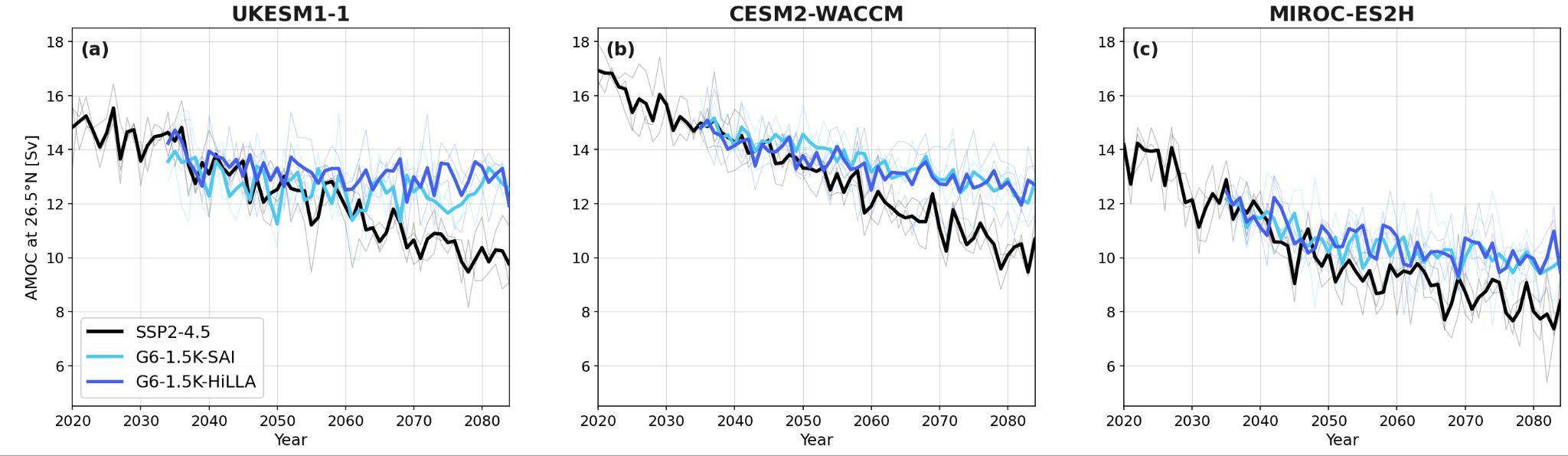
Figure 1 (from Smith et al., forthcoming; “Could Stratospheric Aerosol Injection Prevent Subpolar Gyre Tipping? An Assessment with Three Earth System Models”): AMOC strength in three climate models for the two recent GeoMIP scenarios G6-1.5K-SAI and G6-1.5K-HiLLA, and under the background warming scenario SSP2-4.5.
Surface warming and freshwater input in the North Atlantic are key drivers of AMOC decline, since both act to reduce deep convection there. SAI is expected to reduce changes in both of these drivers, both through local cooling and through reduced ice melt. All earth system modeling supports this sign of effect; if SAI includes Northern hemisphere injection, models find at least some increase in AMOC strength relative to the warming scenario without SAI (Moore et al., 2019; Tilmes et al., 2020; Xie et al., 2022; Pflüger et al., 2024; Zhao et al., 2025; Futerman et al., 2025; Bednarz et al., 2025). If injection is confined to only the southern hemisphere, which is unlikely to be a useful strategy given the known impacts of hemispheric asymmetry in deployment, then modeling suggests there would be little associated AMOC recovery (Bednarz et al., 2025).
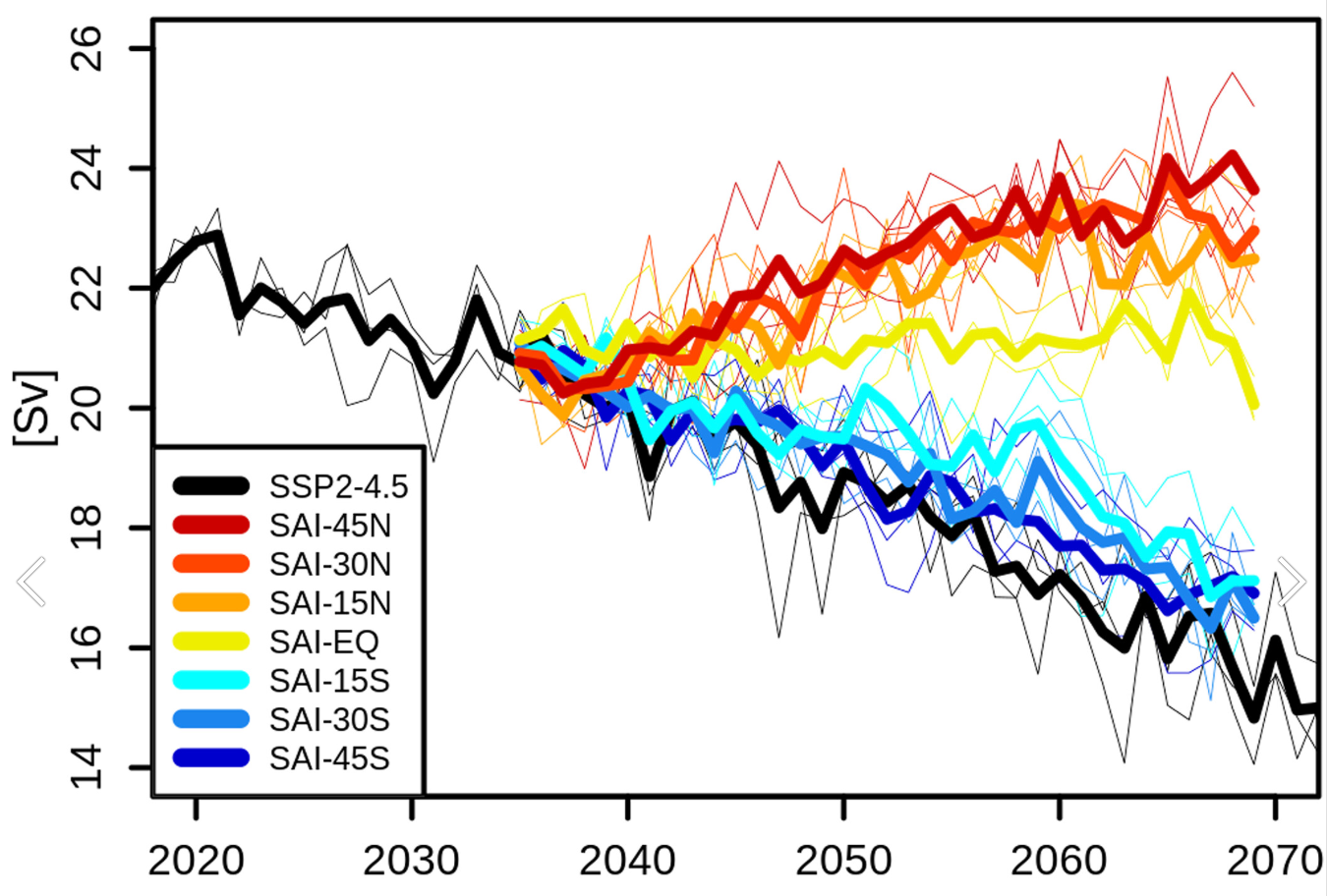
Figure 1: from Bednarz et al., (2025), AMOC strength, in Sverdrup (Sv), in CESM2-WACCM simulations using constant injection of 12 Mt SO2 yr-1 at various different injection latitudes.
A further key uncertainty is how SAI’s impact depends on the timing of deployment. The nature of tipping dynamics means that restoring the drivers (e.g. North Atlantic surface climate and freshwater input) back to an earlier state with SAI might not be sufficient to restore the AMOC itself. Similarly it is likely that some decline of AMOC strength would continue even if global mean temperature is held constant using SAI, due to inertia; continued decline would be stronger if tipping dynamics are already onset (Pflüger et al., 2024; Futerman et al., 2025). At present, we have limited confidence in predictions of how varying the deployment start timing and magnitude of cooling under SAI scenarios would impact AMOC restoration. Pflüger et al. (2024) show SAI beginning in 2080 cannot rapidly restore AMOC strength back to early century levels in one model, while Brody et al. (2024) show SAI beginning in 2045 was nearly as effective as starting in 2035. Further work is needed to explore this scenario space more fully, and to develop a mechanistic understanding of how SAI interacts with AMOC tipping dynamics.
A related tipping risk applies specifically to deep convection in North Atlantic subpolar gyre (SPG), which could abruptly decline on time-scales much faster than AMOC as whole (Loriani et al., 2025). A collapse of SPG convection would cause North Atlantic cooling and various associated changes to regional climate (Sgubin et al., 2017), and would also contribute to AMOC decline. It is likely that SAI would reduce the risk of SPG tipping (Futerman et al., 2025; Pflüger et al., 2024), although at present only Pflüger et al. (2024) have assessed deep convection changes in the SPG under SAI simulations.
References
18Have feedback on this entry?
Spot something off, missing, or worth adding? We’d love to hear from you.
Share feedback