
- Uncertainty
- Low
- Decision relevance
- Medium
- Resolvability scale
- Long-term sustained deployment
Sulfate aerosols in the stratosphere do not only reflect shortwave radiation, but also absorb both the earth’s outgoing longwave radiation and the sun’s incoming near-infrared. As a result, stratospheric aerosol injection (SAI) using sulfur would produce a heating of the lower stratosphere. The resulting change to stratospheric temperature and its latitudinal gradients would cause changes to stratospheric dynamics which then project onto surface climate, such as via changes to position and strength of tropospheric jets and the polar vortices. It would also drive an increase in stratospheric water vapor which acts as a greenhouse gas, offsetting a small part of the SAI cooling. These changes are expected to be larger for equatorial injection (Figure 1), due to the higher outgoing terrestrial longwave radiation in the tropics and the confining effect of the tropical pipe acting to increase aerosol concentrations there. As a result, reducing this stratospheric heating and its accompanying dynamical changes is one argument for extra-tropical injection locations, as well as for exploring alternative particles to sulfates which could achieve lower heating rates (e.g. Vattioni et al., 2025).
Metric
Excluding stratospheric heating in ESM simulations of SAI with injection at 30N/S reduces the root mean square error (RMSE) in temperature or precipitation, over the full annual cycle, relative to the baseline ('target') climate state by a factor of two or more.
Uncertainty
The fundamental mechanisms for the impacts of tropical stratospheric heating are well understood dynamically, and volcanic eruptions (plus ozone loss driving the opposite sign of effect) provide observational evidence, although this has sometimes been overinterpreted given that signals are often too small to observe against internal variability (Polvani et al., 2019; Banerjee et al., 2021). However, a quantitative assessment of the contribution to residual climate changes against the baseline under an SAI scenario similar to our assumed one is not available, so modelling does not give us a straightforward route to assigning probability to this metric. Significant regional changes are attributable to heating in the simulations of both Simpson et al. (2019) and Golja et al. (2026). The former uses a scenario with injection mostly at 30°N/S (although with a very large amount of cooling) and the latter uses equatorial injection. Based on these results, we suggest that under 30°N/S injection, passing this metric is unlikely although not implausible, and we assign a ‘low’ uncertainty.
Decision relevance
Stratospheric heating is one of the major asymmetries between the response of the climate to greenhouse gas forcing and its response to reflective sulfate aerosols. Passing this metric would make stratospheric heating the dominant source of regional residual changes against the baseline state under SAI. Even if this metric is not met when aggregating over the globe and over seasons, there are potentially important regional impacts, such as winter precipitation reductions over Southern Europe (Jones et al., 2021) and South Asian monsoon weakening (Simpson et al., 2019). However, residual changes versus the baseline under SAI are generally smaller than the direct impact of avoided warming. If heating contributes a majority of these changes, then it would materially impact the side-effects of SAI, but we judge it unlikely to alter the overall cost-benefit of deployment, and so assign a medium decision relevance. The reduction in overall cooling efficacy of SAI via stratospheric water vapor response increases the total injection required to achieve a given cooling by perhaps 5% for equatorial injection (based on the multi-model mean in Golja et al. (2026)). This effect has substantial inter-model variation, making it a potentially important source of model uncertainty in overall SAI efficacy (Golja et al., 2026), and providing a second argument for the decision relevance of this uncertainty.
Further Information
Figure 1 demonstrates the magnitude of stratospheric heating under sulfate SAI – up to around 10K for an equatorial injection of 10 Mt yr-1 – and how this reduces with extra-tropical injections. For context, under greenhouse gas warming, a cooling of the stratosphere is occurring, by around 2K since 1980 (Santer et al., 2023). SAI-driven stratospheric heating could therefore outweigh this cooling trend under large-scale low-latitude injection.
In the Northern Hemisphere extra-tropics, the expected responses to tropical stratospheric heating include a strengthened polar vortex, a more positive North Atlantic Oscillation/Northern Annular Mode and a poleward shift of the tropospheric eddy-driven jets (e.g. Robock, 2000). Golja et al. (2026) recently demonstrated the robustness of these effects in response to SAI-driven heating in a multi-model context. These changes are associated with various impacts on surface climate including northern Eurasian residual warming (which manifests as incomplete cooling rather than an absolute warming under SAI), additional cooling over north east Canada and Greenland, and southern European drying (Banerjee et al., 2021; Jones et al., 2021; 2022). Impacts of this kind have been identified following large volcanic eruptions (e.g. Robock & Mao, 1992; Shindell et al., 2004), although detecting one-off responses to eruptions can be difficult given large year-to-year variability (Polvani et al., 2019).
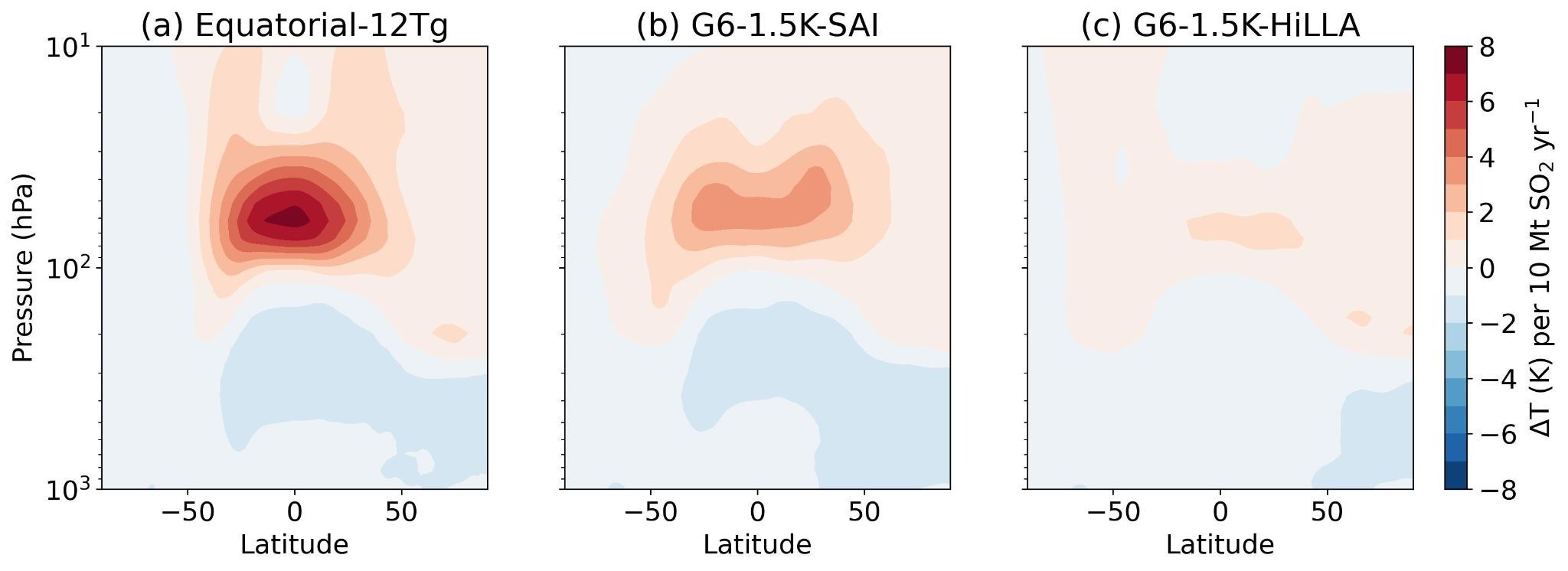
Figure 1: Boreal summer (JJA) change in zonal-mean temperature on pressure levels for CESM2-WACCM under equatorial injection of 12 Mt per year (simulations from Visioni et al. (2023)), G6-1.5K-SAI (30°N/S injection) and G6-1.5K-HiLLA (60°N/S, 15km, spring-time injection), shown normalized by annual injection magnitude.
In the tropical stratosphere, heating impacts the quasi-biennial oscillation (QBO), potentially locking it into a permanent westerly phase at high injection magnitudes (Aquila et al., 2014). This would have dynamical impacts both locally and outside the tropics (Gray et al., 2018). Additionally, lower stratospheric heating could reduce tropical precipitation by suppressing convection (Ferraro et al., 2014). It has also been associated with dynamically-driven redistribution of tropical rainfall (Simpson et al., 2019) and a reduction in the South Asian summer monsoon strength (Asutosh et al., 2025).
In the Southern Hemisphere, a poleward shift of the polar tropospheric jet and strengthening of surface westerlies is expected with tropical lower-stratospheric heating. This is associated with a potential under-restoration of Antarctic sea-ice (McCusker et al., 2015) also seen with large volcanic eruptions (Zanchettin et al., 2014). This mechanism may also drive warm water upwelling under vulnerable West Antarctic ice shelves, which, it has been suggested, could limit SAI’s ability to prevent dynamic mass loss from the West Antarctic Ice Sheet (McCusker et al., 2015). As above, this result likely depends strongly on injection strategy; Goddard et al. (2023) demonstrate that injecting outside of the tropics largely avoids these impacts, and injecting South of the tropics in the Southern Hemisphere could produce the opposite sign of Southern Annular Mode response to equatorial or Northern Hemisphere injections (Bednarz et al., 2022).
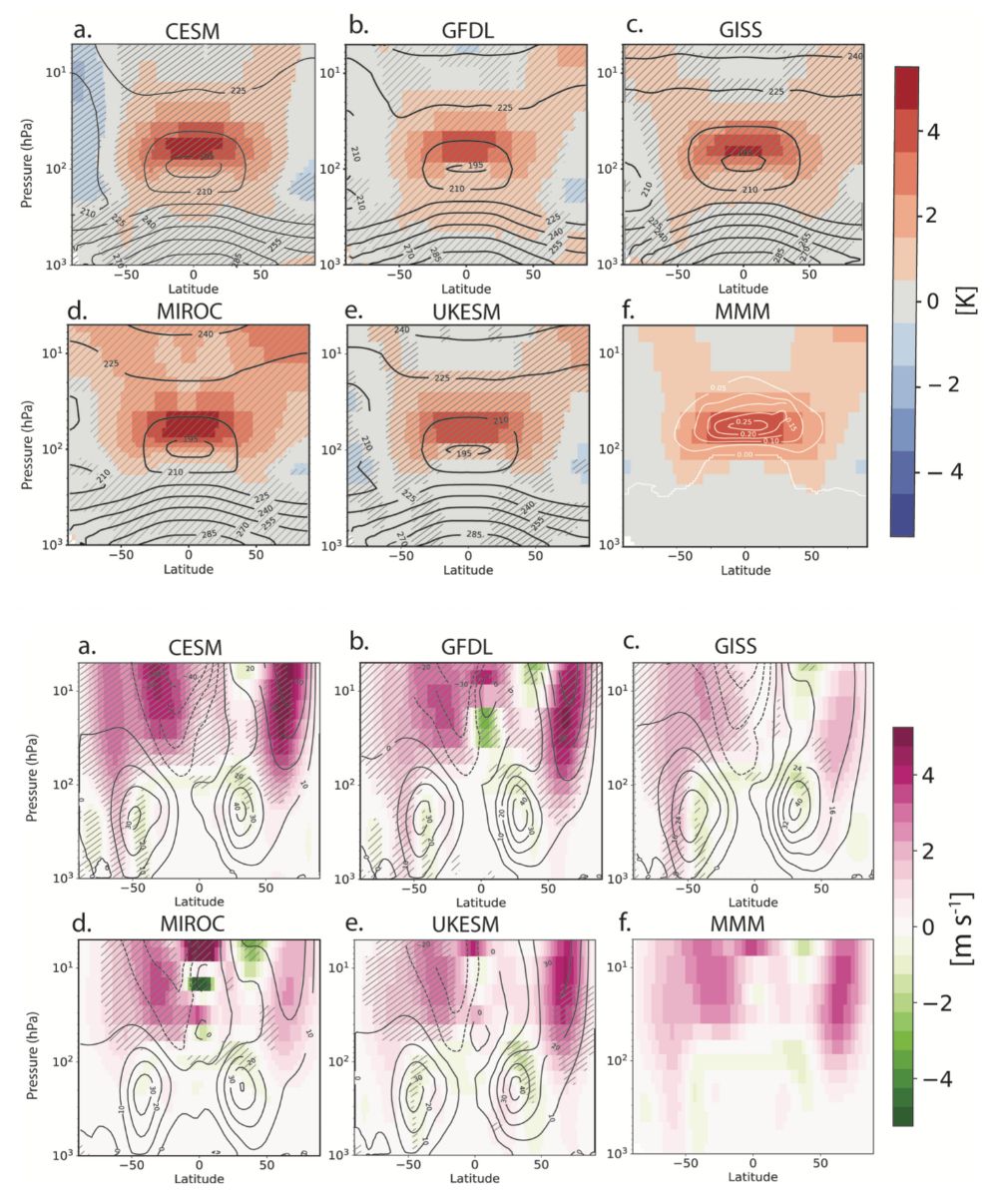
Figure 2, from Golja et al., 2026 (preprint, their Figures 2 and 4). Left: Stratospheric temperature change from an applied heating tendency (set to represent heating from an equatorial SAI strategy achieving a 4 Wm-2 global radiative forcing). Right: the resulting change in zonal winds in Boreal winter (DJF), shown in colors, and the seasonal climatology (contours). Hatching shows changes that are significant, using a Welch’s t-test and controlling for false discovery rate at 95% confidence.
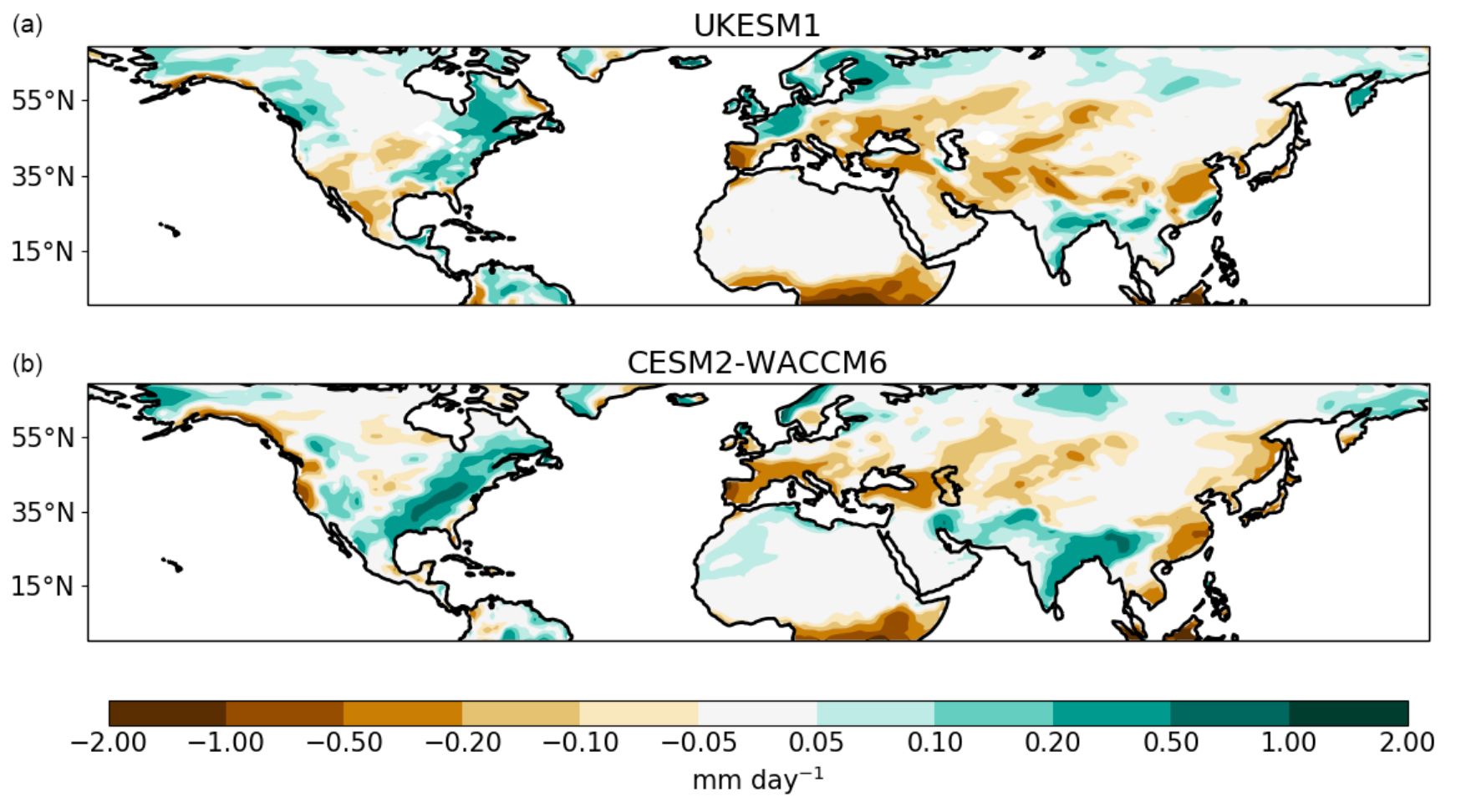
Figure 3 (from Jones et al., 2021): difference in precipitation between G6sulfur and G6solar during December–February over 2081-2100. The comparison is between two GeoMIP scenarios cooled to the same global temperature, one using SO2 injection (G6sulfur) and therefore including stratospheric heating, the other using insolation reduction so without stratospheric heating (G6solar). Note that the two scenarios also see different equator-to-pole gradients of sunlight reflection, affecting the pattern of surface temperature response, which will also influence the precipitation field shown.
Separately from the above, warming of the tropical cold-point tropopause via aerosol heating also increases the entry of water vapor into the stratosphere. Given that stratospheric water vapor acts as a greenhouse gas, this effect reduces the overall cooling efficacy of SAI. Golja et al. (2026) report a multi-model mean increase in stratospheric water vapor of around 0.9 parts per million, equivalent to roughly 0.2 Wm-2 radiative forcing at the tropopause, under heating derived from an SAI scenario with injection magnitudes equivalent to a 4 Wm-2 negative radiative forcing. A similar magnitude of moistening is seen in the simulations of Lee et al. (2023) at injection magnitudes of around 20 Mt/yr.
Future research directions
Few simulations have isolated the impact of stratospheric heating, although with some exceptions (e.g. Simpson et al., 2019; Banerjee et al., 2021; Golja et al. 2026). Additionally, while it is understood that the impacts of stratospheric heating depend strongly on the meridional pattern of the heating – e.g. with equatorward rather than poleward jet shifts under high latitude heating (Haigh et al., 2005) – most analysis has focused on low-latitude heating scenarios. Some studies have explored the latitudinal dependency of the response to heating (e.g. Bednarz et al., 2022), but doing this across plausible scenarios in a multi-model setting could be a useful next step.
Other important future research could include improvements to earth system models to more faithfully represent stratospheric processes and stratosphere-troposphere coupling, new idealized experiments to test mechanisms for heating impacts, and additional use of natural analogues.
References
22Have feedback on this entry?
Spot something off, missing, or worth adding? We’d love to hear from you.
Share feedback