
- Uncertainty
- Medium
- Decision relevance
- High
- Resolvability scale
- Long-term sustained deployment
SAI is anticipated to have near-zero (Lee et al., 2021; Parry et al., 2026; Zhao et al., 2024) or slightly negative (Yang et al., 2020) changes on plant growth relative to background warming scenarios. Changes are strongly linked to precipitation changes, with changes in diffuse radiation, temperature, and nutrient availability also playing a role. SAI likely has a positive impact (of >10%) on global crop yield relative to background warming scenarios, primarily driven by decreased temperatures. While regional crop impacts are more uncertain and may not be as positive, it is unlikely that they are significantly decreased.
Metric
SAI at 0.5°C of cooling decreases crop yield by more than 10% in any given IPCC region, except where this reduction represents a missed benefit to crop yield arising from warmer temperatures without SAI.
Uncertainty
The existing literature does not precisely map onto our quantitative framing or scenario, and so this assessment necessarily involves interpretation across several closely related analyses, figures from which are compiled in the appendix here. Fig. 1 shows that when comparing several SAI scenarios against the background warming scenario, SSP2-4.5, every country except two, South Africa and Madagascar, have increased total calorie output under SAI. While Madagascar is its own IPCC region, a second assessment (under different scenarios), shown in Fig. 2, finds SAI produces a strong increase in crop yield. Total calorie output also increases when the same scenarios are compared in Clark et al. (2023). Fig. 3 is also useful here, which shows a country specific breakdown of the top ten producers of four major crops. Outside of countries with large cold regions (Russia and Canada), which SAI impacts negatively due to decreased temperatures, almost every combination of scenarios increase yields. Lastly, Fig. 4 shows that many of the very local negative impacts shown in Fig. 2 are offset at the larger regional scale, producing positive impacts on crop yield from SAI overall. Taking these assessments together, we believe a greater than 10% reduction in crop yield due to SAI for one IPCC region is plausible (>10% chance), even if unlikely for a given region given the overall positive expected impact, motivating a medium uncertainty level.
Decision relevance
A decrease in crop yield by 10% can potentially, depending on the region, have a significant impact on food security such that it would materially impact the cost benefit of a decision to deploy SAI. This is supported by the methodology put forward in Kraklow et al. (2025) to analyze the impact of future drought on food security, where a ≤5.1%, 5.1–11.3%, and ≥11.3% decrease in plant production represent low, intermediate, and high impacts, respectively.
Further Information
Drivers of plant growth changes under SAI
Plant growth changes under SAI compared to a no-SAI future have mixed projections throughout the literature. Net primary production changes range from near-zero (Lee et al., 2021; Parry et al., 2026; Zhao et al., 2024) to ~-5.49% (Yang et al., 2020). NPP changes are significantly linked to precipitation and (P - E) changes under SAI (Duan et al., 2020; Lee et al., 2021; Tjiputra et al., 2016). While the sign of precipitation changes varies by model and scenario, there is not a large enough trend in either direction to produce a meaningful quantitative estimate for this effect. The precipitation driver is most relevant at regional scales, while it is less significant at the global level. Next, the diffuse-light fertilization effect is plausibly large but inconsistently represented across models. An SAI-driven increase in diffuse radiation between 11% (Xia et al., 2016) and 50% (Yang et al., 2020) serves to increase photosynthesis rates and therefore plant growth. Xia et al. find this increase, combined with SAI-induced cooling, leads to a 3.8 PgC/yr increase in global primary production (GPP) (the study does not report a quantitative result for NPP). The wide range in diffuse/direct radiation changes contributes uncertainty to the extent — rather than to whether — terrestrial plant growth increases through this pathway. Additionally, many models underestimate the reduction in plant production under SAI compared to future scenarios due to nitrogen limitation not being considered. Under the cooler temperatures caused by SAI, soils will decompose slower and decrease the supply of mineral nitrogen for plants to uptake (Duan et al., 2020; Parry et al., 2026). This decreases the expected effectiveness of SAI at increasing plant growth relative to a non-intervened future.
Analysis of agriculture-specific impacts of SAI
The drivers of agricultural production changes under SAI are similar to overall plant growth changes, but the weighting of each driver is different. Global crop yields are modeled to increase (at minimum by around 10%) under a variety of SAI scenarios when compared to a variety of future no-SAI scenarios, including ones achieving the same temperature with emissions reductions. This is primarily driven by reduced temperatures increasing crop yield in mid- and equatorial latitudes (Fig. 1) (Clark et al., 2023; Fan et al., 2021).
Where SAI is modeled to decrease rather than increase crop production, this is primarily due to localized precipitation reductions, of which modeling uncertainty is high. There are also cold regions where crop yields are expected to increase with warming under climate change, and SAI would reverse this temperature driven crop production benefit. We do not include these impacts in our metric below. They are not a specific risk of SAI but would occur under emissions mitigation as well (Clark et al., 2023; Fan et al., 2021).
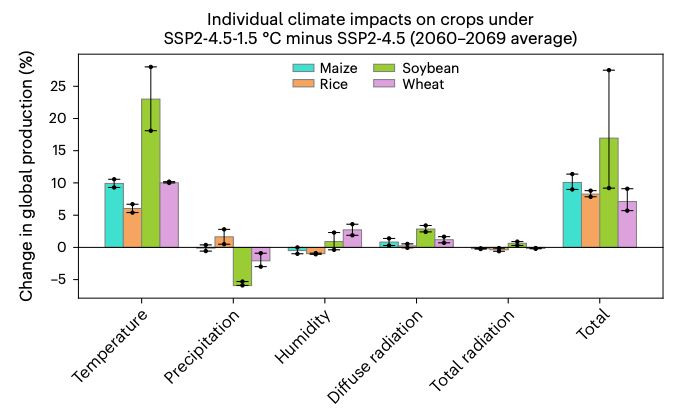
Figure 1, from Clark et al. (2023): Change in global production of four major crops under SAI at low-latitudes to maintain global surface temperatures at 1.5°C (ARISE-SAI-1.5, labeled as SSP2-4.5-1.5°C here) compared to SSP2-4.5, broken down by the driver.
One additional factor that should be considered is the potential for SAI to reduce the protein content in key crops that some already protein-deficient countries rely on for protein intake. This could occur because protein content may reduce with higher future CO2 levels. While this effect is expected to be offset by increased protein contents resulting from higher temperatures, SAI prevents this from happening by decoupling temperature increases from CO2 increases. Clark et al. (2025) were the first to assess this mechanism and report that SAI relative to climate change reduces maize protein intake by 30% and rice protein intake by 10% for countries that rely on maize and rice for their protein, respectively. Given the significant modeling uncertainty and limited literature on this topic, we have not included it in the metric. However, if the body of research concerning this impact becomes large it may need to be revisited.
References
21Have feedback on this entry?
Spot something off, missing, or worth adding? We’d love to hear from you.
Share feedback