
- Uncertainty
- Medium
- Decision relevance
- Low
- Resolvability scale
- Long-term sustained deployment
The terrestrial biosphere currently absorbs roughly a quarter of anthropogenic CO2 emissions through plant photosynthesis, with the absorbed carbon stored in living vegetation and in soils. SAI would affect this carbon sink through three main pathways: altered autotrophic (soil) and heterotrophic (plant) respiration due to decreased surface temperatures, altered plant growth from the combination of changes to radiation, temperature and precipitation, and changes to permafrost . Because most of these effects act in the same direction — toward greater land carbon storage relative to the warmer world without SAI under the same GHG emissions — most modelling studies project that SAI would enhance the terrestrial carbon sink (Parry et al., 2026; Tjiputra et al., 2016; Xia et al., 2016; Yang et al., 2020; Zhao et al., 2024). Overall, increased future emissions result in a 4-5% (150-200 PgC) increase in global terrestrial carbon storage under an SAI scenario by 2050-2069 (Parry et al., 2026; Yang et al., 2020; Zhao et al., 2024), with SAI accounting for an additional 8.8 (Yang et al., 2020), ~60 (Parry et al., 2026), and 79 (Zhao et al., 2024) PgC additional increase on top of this, depending on the study (see the uncertainty level description below for more details on the scenarios being compared). There is greater uncertainty in the regional patterns of these changes which is not accounted for here, since we focus on the global totals.
Metric
SAI at 0.5°C of cooling does not increase terrestrial carbon storage relative to the background warming scenario.
Uncertainty
The current literature all points to slight increases in terrestrial carbon storage when SAI is implemented when compared to non-intervened future scenarios. Parry et al. (2026) find a ~60 PgC in terrestrial carbon storage under SAI implementation (to bring temperatures from SSP5-8.5 to SSP2-4.5 levels) vs. SSP5-8.5 by the end of the century. Yang et al. (2020) find an additional 79 PgC of terrestrial carbon storage at the end of the century with SAI maintaining current temperature compared to RCP8.5 (Figure 1, below). Zhao et al. (2024) find a smaller increase of 8.8 PgC with similar SAI implementation relative to SSP2-4.5, but it is important to note that these findings are based on results from mid-century (2050-2069) instead. Despite the current literature all pointing to an increase in storage, the significant uncertainty in the drivers — particularly as it pertains to plant growth — and limited model diversity drive us to classify this as medium.
Decision relevance
Even if SAI does not increase terrestrial carbon storage and instead has no impact or a slight negative effect, it is unlikely to have an impact significant enough to change a decision to deploy.
Further Information
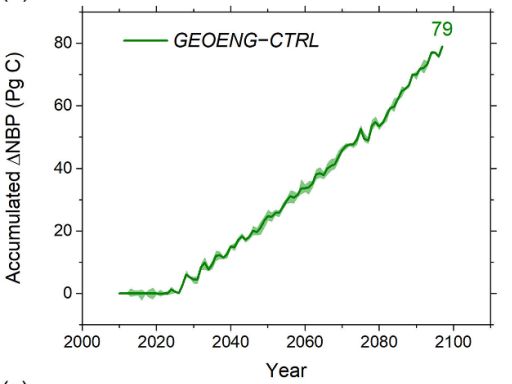
Figure 1, from Yang et al. (2020): Change in net biome production (NBP, used to examine terrestrial carbon storage) under SAI to maintain temperatures at 2020 levels (GEOENG) from RCP8.5 (CTRL) between 2010-2100.
The mechanisms by which SAI alters the terrestrial carbon cycle are well-identified by the literature, but the magnitude of their effects are uncertain. CO2 fertilization, in which higher atmospheric CO2 enhances gross primary productivity (GPP), is the dominant driver of increased terrestrial carbon uptake in future scenarios, regardless of sunlight reflection (Duan et al., 2020; Glienke et al., 2015; Parry et al., 2026). Additionally, the cooling caused by SAI also suppresses autotrophic and heterotrophic respiration, slowing the release of stored carbon back to the atmosphere (Tjiputra et al., 2016; Xia et al., 2016; Yang et al., 2020; Zhao et al., 2024).
Stratospheric aerosols also scatter incoming sunlight, increasing the diffuse fraction of surface radiation and increasing photosynthesis rates (Duan et al., 2020; Xia et al., 2016; Yang et al., 2020). Additionally, precipitation changes under SAI are strongly linked with plant growth and therefore carbon uptake, resulting in a significant range of uncertainty — albeit with a small magnitude (Futerman et al., 2025; Lee et al., 2021; Tjiputra et al., 2016).
Explain sources of uncertainty and state of understanding
Under SAI, soil carbon storage increases primarily due to increased vegetation carbon leading to increased litterfall and uptake by the soil. This is complemented by decreased autotrophic respiration due to lower temperatures decreasing carbon release (Tjiputra et al., 2016; Yang et al., 2020; Zhao et al., 2024). Yang et al. (2020) and Zhao et al. (2024) both find this to be the primary driver of increased terrestrial carbon storage. Through a similar pathway, heterotrophic respiration will also slow under SAI-driven cooler temperatures, with a positive impact about half as large as the autotrophic impact observed (Yang et al., 2020).
Please see the XXXX section in the Terrestrial Vegetation uncertainty for a detailed description of plant growth changes under SAI. The following analysis of Clark et al. (2026) is a carbon storage specific addition to that section. SAI-induced cooling will protect against the vapor pressure deficit (VPD) increase predicted due to climate warming. This VPD increase was seen to decrease European tree carbon storage by up to 30% when CO2 is kept constant (Clark et al., 2026), a consequence that may be avoided with SAI. All the drivers discussed in this paragraph are largely model dependent, and therefore more inter-comparison modelling with improved representation of plant processes is required.
SAI is also likely to prevent some greenhouse gas (both CO2 and methane) release through the reduced melting of permafrost. Two review papers concluded that while a reduction in melting is likely, it is unlikely to fully compensate for the melting caused by increasing temperatures (Duffey et al., 2023; Futerman et al., 2025). Though, it is important to note that the inter-model spread in these results is quite large — and in some cases larger than the difference between SAI and non-SAI scenarios (Chen et al., 2020). More specifically, SAI reduced carbon release from permafrost loss compared to RCP4.5 by 50% and 40% for carbon dioxide and methane, respectively. These changes equate to around 14PgC kept in the ground (Chen et al., 2020). It is likely that SAI strategies that target restoring polar temperatures would be more effective at preventing permafrost melt (Futerman et al., 2025). Overall, these reductions in permafrost loss contribute to the increased soil carbon storage under SAI compared to a continued warming scenario.
References
12Have feedback on this entry?
Spot something off, missing, or worth adding? We’d love to hear from you.
Share feedback